How to create an effective SEO content strategy in 2026
How to create an effective SEO content strategy in 2026. Publishing content without a clear strategy is one of the most common mistakes website owners make. Articles written at random,...

How to create an effective SEO content strategy in 2026. Publishing content without a clear strategy is one of the most common mistakes website owners make.
Articles written at random, without keyword research or editorial planning, rarely produce major results in organic rankings.
In 2026, an SEO content strategy must take into account the changes brought by artificial intelligence in search. Google AI Overviews, conversational searches and E-E-A-T evaluation are changing the way these strategies work.
Generic, superficial content no longer works. Google looks for demonstrable experience, practical experience and real value for the user.
In this guide, you will learn how to build an effective SEO content strategy in 2026. From keyword research and creating an editorial calendar to structuring content into pillar pages and topic clusters, the methodology that dominates SEO strategies in 2026.
How to create an effective SEO content strategy in 2026
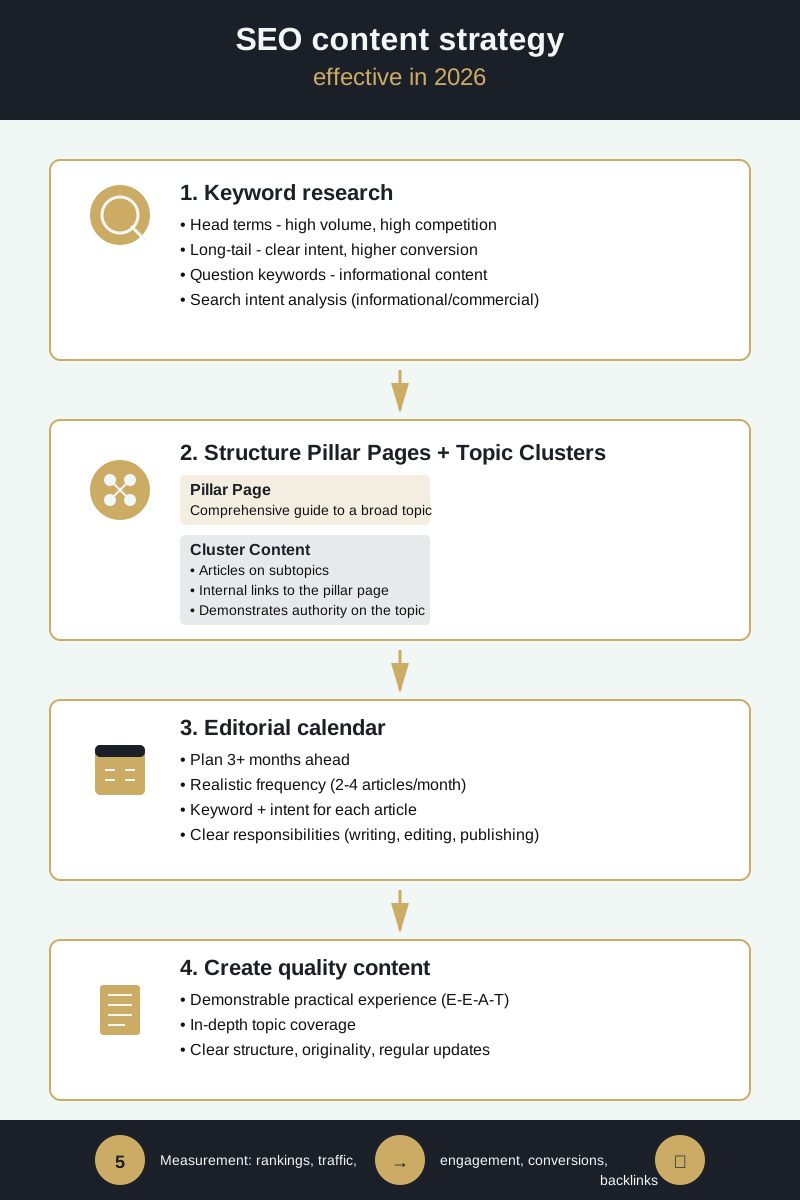
An effective SEO content strategy is built on four pillars: keyword research, editorial planning, content structure and measuring results.
Each pillar contributes to a system that generates growing organic traffic over the long term.
Keyword research in 2026
Keyword research remains the foundation of any content strategy, but the approach has changed significantly. Instead of focusing on individual high-volume keywords, build topic clusters that cover a subject in depth.
Types of keywords
- Head terms: short keywords with high volume and strong competition (for example, "SEO"). Hard to rank for, but important for topical authority
- Long-tail keywords: longer phrases with lower volume but clear intent (for example, "how to do SEO for a new blog"). Easier to rank for and with a higher conversion rate
- Question keywords: questions users ask Google (for example, "what is SEO and how does it work"). Ideal for informational content and FAQs
Research tools
- Google Search Console: shows the keywords your website already appears for, including average position and CTR
- Google Trends: identifies search trends and keyword seasonality
- Google Autocomplete and People Also Ask: provide long-tail keyword ideas based on real user searches
- Ahrefs, Semrush, Ubersuggest: paid tools with detailed data on volume, difficulty and competition
Search intent analysis
Each keyword has a specific search intent. Creating content that does not match that intent is a waste of resources. The four types of intent:
- Informational: the user is looking for information ("what is technical SEO"): create guides and educational articles
- Navigational: the user is looking for a specific website ("Google Search Console"): do not target these searches
- Commercial: the user is comparing options ("SEO optimisation services prices"): create comparison pages and reviews
- Transactional: the user is ready to act ("professional SEO services"): create optimised landing pages
Structuring content with pillar pages and topic clusters
The pillar-cluster model is the recommended content organisation strategy for SEO in 2026. Instead of isolated articles, create a network of interconnected content that demonstrates expertise on a subject.
Pillar page
A long, detailed page covering a broad subject (for example, "What is SEO? Complete guide"). The pillar page addresses the subject at a general level and links to cluster articles that explore specific subtopics in depth.
Cluster content
Individual articles that explore subtopics of the pillar subject in depth. Each cluster article links back to the pillar page, creating a network of internal links that signals the website's authority on that subject to Google.
Example of a pillar-cluster structure for the subject "SEO":
- Pillar: What is SEO: Complete guide
- Cluster: How Google's algorithm works
- Cluster: Link building strategies
- Cluster: Rich snippets and structured data
- Cluster: Core Web Vitals and performance
- Cluster: SEO for online shops
The editorial calendar
An editorial calendar turns the strategy into a concrete action plan. Plan content at least 3 months in advance to keep publishing consistent.
Elements of an effective editorial calendar:
- Publication date: set a realistic frequency (2-4 articles per month for most websites)
- Title and main keyword: each article targets a specific keyword
- Search intent: confirm that the content type matches the intent
- Pillar/Cluster: mark which pillar page each article belongs to
- Person responsible: who writes, who edits, who publishes
- Status: researching, drafting, editing, published
Creating content that ranks in 2026
Content that achieves good rankings in 2026 stands out through quality, depth and demonstrable experience:
- Practical experience: include real examples, case studies, your own data and perspectives based on your direct experience. Google E-E-A-T evaluates the author's experience
- Depth on the subject: cover the subject fully, not superficially. Answer all the questions a user might have
- Clear structure: use descriptive headings, lists, tables and visuals to make the content easy to scan
- Regular updates: outdated content loses rankings. Update important articles at least annually with new information and data
- Originality: in the age of AI-generated content, Google rewards original content with a unique perspective
Measuring and optimising results
Monitor each article's performance to understand what works and what needs adjusting:
- Average position: track changes in Google Search Console
- Organic traffic: measure visits from organic search per article
- Time on page and engagement: a long time on page indicates valuable content
- Conversions: how many organic visitors become customers or leads
- Backlinks attracted: quality content attracts natural links from other websites
Every strategically published article, every completed cluster and every update to existing content contributes to growing your website's authority on the targeted subjects.
Start with keyword research, structure content into pillar pages and clusters, maintain a consistent editorial calendar and measure results. This is the path to sustainable online visibility in 2026 and beyond.
Source references
Dorel Tănase
Original author at GOAI. Published here in English with permission.