What is Claude AI and how is it used?
What is Claude AI and how is it used? Claude AI models, costs, capabilities and the right choice for your business. Anthropic offers three categories of AI models under the Claude name:...

What is Claude AI and how is it used? Claude AI models, costs, capabilities and the right choice for your business.
Anthropic offers three categories of AI models under the Claude name: Opus, Sonnet and Haiku. Each category exists for a different type of task, with prices and performance to match.
If you have a business in Romania and want to integrate artificial intelligence into your workflow, whether for content writing, programming or data analysis, choosing the right model can save you hundreds of dollars a month.
The current model family includes:
- Claude Opus 4.6 (the most advanced)
- Claude Sonnet 4.5 (the balanced model)
- Claude Haiku 4.5 (the fastest and cheapest)
The three Claude models and each one's role
Claude Opus 4.6: the top model
Opus 4.6 is the most intelligent model in the Claude family, released on
5 February 2026. It supports a context window of up to 1 million tokens (in beta), meaning it can process very long documents, equivalent to hundreds of pages in a single interaction.
The model excels at complex reasoning, advanced programming and tasks requiring long-term planning.
Opus is recommended when you need:
- Detailed analysis of complex legal, financial or technical documents
- Programming tasks involving multiple files and interdependent logic
- Agentic workflows: where the model must make decisions across several steps without human intervention
Claude Sonnet 4.5: the balance between quality and cost
Sonnet 4.5 occupies the middle position. It is not as powerful as Opus at extreme reasoning tasks, but it is much faster and costs less.
It supports a standard context window of up to 200.000 tokens, with the option to extend it to 1 million tokens (at double the input cost).
Sonnet is suitable for:
- Content generation: articles, emails, technical documentation
- Medium-complexity programming tasks, code review, debugging
- Automating customer support and processing large volumes of text
Likewise, a marketing agency producing dozens of SEO articles a month will find the best balance between quality and budget in Sonnet.
Claude Haiku 4.5: speed and efficiency at low cost
Haiku is the smallest and fastest model in the family. It responds almost instantly and costs a fraction of the price of the other models.
The context window is 200.000 tokens, and the maximum output is 64.000 tokens.
Haiku works best for:
- Automatic classification of messages, tickets or emails
- Short summaries, structured data extraction from documents
- Real-time interactions where response speed matters more than depth of analysis
Claude model costs: subscriptions and API
Subscription plans for use through the interface
Anthropic offers several plans for access to Claude through the claude.ai website or mobile app. The prices are valid as of February 2026:
- Free: limited access to Sonnet, no access to Opus or advanced features such as Extended Thinking
- Pro: 20 $/month (or approximately 17 $/month with annual payment): access to all models including Opus 4.6, a usage limit of around 5x the free plan, access to Claude Code, Google Workspace integrations
- Max 5x: 100 $/month: 5 times more usage than Pro, priority access, suitable for professionals who work with Claude daily
- Max 20x: 200 $/month: 20 times more usage than Pro, maximum access to all features
API pricing: pay per token
If you integrate Claude into your own application or use it through the API, you pay based on the tokens consumed. A token represents approximately 4 characters or 0,75 words in English. For Romanian, the ratio may be slightly different. Prices per million tokens are:
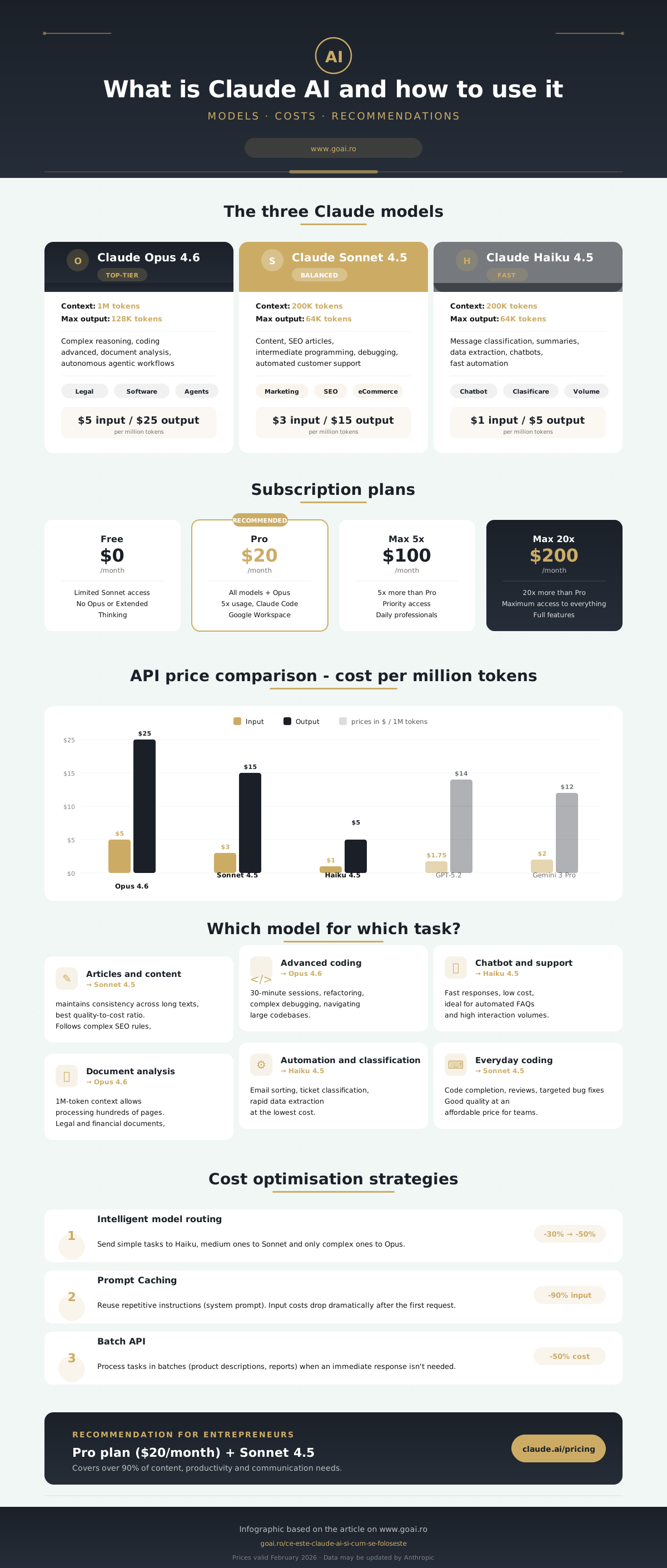
- Claude Opus 4.6: 5 $ input / 25 $ output
- Claude Sonnet 4.5: 3 $ input / 15 $ output
- Claude Haiku 4.5: 1 $ input / 5 $ output
To put the figures in context: if a support chatbot processes 500 conversations daily, each with 500 input tokens and 200 output tokens, the monthly cost with Haiku would be under 10 $. The same task on Opus would cost 5 times more, which is why choosing the right model matters.
Which model is better for writing articles and content
If your main activity is creating content, blog articles, commercial copy, newsletters or social media communication, the choice comes down to Opus and Sonnet.
Sonnet 4.5 is the best choice for regular content production. It follows complex instructions (such as a set of SEO rules with required vocabulary and forbidden expressions), maintains consistency in long texts and produces natural Romanian text. Its generation speed is higher than Opus's, which matters when producing a large volume of content.
Opus 4.6 is worth using for texts that require complex reasoning, for example, in-depth technical articles, comparative analysis of several sources or content that combines data from lengthy documents. For standard SEO articles, the quality difference compared with Sonnet does not justify the higher price.
Haiku is not recommended for long articles. It can overlook detailed instructions and produces less subtle text in the 1500-2000-word format.
Which model is better suited to programming and development
Programming is the field where the differences between models become most visible. Opus 4.6 achieved better results on real software engineering benchmarks, including refactoring, debugging and developing new features in existing codebases.
This is how the models differ in practice:
- Opus 4.6: complex projects, long programming sessions, agentic workflows where the model operates autonomously across several steps. Opus can work coherently for 30 minutes on a single task
- Sonnet 4.5: medium-complexity programming tasks, code completion, fixing specific bugs, code review. Its value for money makes it ideal for development teams that use Claude daily
- Haiku 4.5: generating simple snippets, code classification, repetitive automation tasks
Quick comparison with other AI models
The AI model market is competitive. Claude Opus 4.6 at 5 $/25 $ per million tokens compares with OpenAI's GPT-5.2 (1,75 $/14 $) and Google's Gemini 3 Pro (2 $/12 $). Opus is more expensive for input, but output prices are in the same range. Sonnet 4.5 at 3 $/15 $ is competitive with GPT-5.2, while Haiku at 1 $/5 $ is in the budget-model category.
The real differences are not only about price. Claude has a recognized advantage in following complex instructions, producing subtle text and working with very large contexts. GPT-5.2 is cheaper for input. Gemini offers native integration with the Google ecosystem. The choice depends on what you are building and what results you expect.
Practical cost optimization strategies
Regardless of the model you choose, there are several techniques that reduce spending without affecting quality:
- Use the right model for each task: do not send a simple question to Opus when Haiku can answer just as well. A routing system that sends simple tasks to Haiku and complex ones to Sonnet or Opus can reduce costs by 30-50%
- Enable Prompt Caching: if you use repetitive instructions (a standard system prompt, for example), caching reduces input costs by up to 90% after the first request
- Batch API for non-urgent tasks: if you generate 50 product descriptions or process a large set of documents, submitting them in a batch reduces the cost by 50%
Recommendations by profile
If you are an entrepreneur or small business owner and use Claude for content writing, emails and general productivity, the Pro plan (20 $/month) with the Sonnet 4.5 model covers over 90% of your needs. For blog articles, customer communication and internal documentation, Sonnet is more than enough.
If you are a developer or lead a technical team, the Max plan (100 $ or 200 $/month) with access to Opus 4.6 and Claude Code allows long programming sessions without interruptions. Alternatively, through the API, use Sonnet for routine tasks and Opus only for complex tasks.
If you are building an application that integrates Claude, the per-token pricing structure is the relevant one. Start with Haiku for high volumes and switch to Sonnet or Opus only where response quality demands it. Monitor token consumption and use caching and batch processing from the start.
Source references
Dorel Tănase
Original author at GOAI. Published here in English with permission.